
Para Hydrogen Induced Polarisation
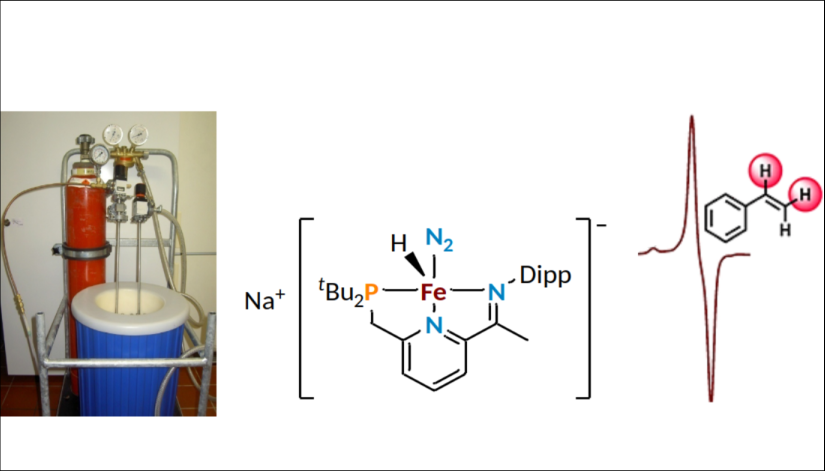
Para-hydrogen-induced polarisation (PHIP) is a powerful method for increasing sensitivity in NMR. One of the most important variants is ‘hydrogenative’ PHIP. It utilises the singlet spin state of para-hydrogen, which is not visible in NMR, and converts it – via a symmetry-breaking mechanism in a hydrogenation reaction – into a detectable product spin state. The detectable spin state is characterised by high nuclear spin polarisation, which can reach several orders of magnitude. Whilst platinum-group catalysts were predominantly used in the past, we are currently investigating alternative iron catalysts in order to establish PHIP for these. These studies help us to understand Fe-based catalytic processes, which are being investigated within the framework of sustainable chemistry at the CRC “Iron Upgraded” (www.chemie.tu-darmstadt.de/iron-upgraded).
Functional materials based on cellulose/paper

One research focus is on functional materials based on cellulose/paper. Through suitable surface functionalisation of the cellulose-containing carrier material with polymers, small organic molecules or biomolecules, these materials can be adapted so that they can be used for energy storage, as sensory or optical components. The Gutmann group develops and applies analytical techniques to identify the surface functionalisations and characterise the structure and dynamics of these disordered materials. As an important tool, they use a combination of solid-state NMR and dynamic nuclear polarisation techniques.
Since September 2023, the group has been involved in the European Innovation Council (EIC) Pathfinder project VanillaFlow (Artificial Intelligence Guided Development of Vanillin-based Flow Batteries)(www.vanillaflow.eu). Here, the group is working on advanced solid-state NMR analyses for novel paper-based membranes that can be used in modern redox flow battery technology.
Structure and processes in sodium/sodium ion battery systems

In 2021, the group began investigating sodium/sodium-ion battery components using ex-situ and in-situ solid-state NMR as part of the EU SIMBA project(www.simba-h2020.eu). Questions such as the structural intercalation of sodium in electrode materials in solid-state battery systems are addressed. In addition, structural changes of the materials under working conditions are investigated to understand processes during cycling that can influence the efficiency and lifetime of the energy storage systems.
Metallic nanoparticles and technical catalysts
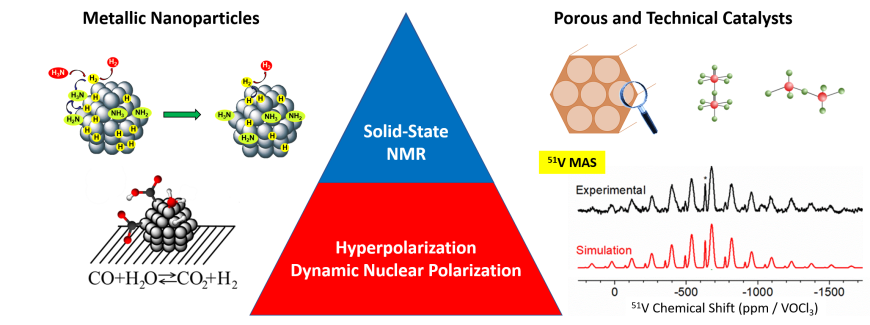
For many years, the group has concentrated on heterogenised catalysts. As examples, metallic nanoparticles and supported catalysts are investigated, which are of great interest for technical reactions such as hydrogenation, CO oxidation, hydroformylation, water-gas shift reaction, etc.. We are interested in identifying catalytic sites and gaining insights into the surface chemistry of these catalyst systems, which is the fundamental step towards their optimisation for technical applications. Here we use a combination of solid-state NMR and gas-phase NMR. Since 2022, the group has been involved in the CRC 1487 "Iron Upgraded"(www.chemie.tu-darmstadt.de/iron-upgraded), where we are working on H/D exchange reactions.