
CO2 Utilization
The anthropogenic greenhouse gas carbon dioxide (CO₂) is primarily generated through the combustion of fossil resources. The three key strategies to achieve a climate-neutral future are 1) the substitution of fossil resources, 2) the extraction and storage of CO₂ (CCS) and 3) the capture and subsequent use of CO2 (CCU) as a chemical building block from the atmosphere and industrial exhaust gases.
Our research focuses on the utilization of CO2 as a C1 building block in catalytic processes for the synthesis of valuable added products. This includes the synthesis of cyclic carbonates, the indirect reduction of CO2 to methanol, the preparation of polycarbonates (PC) and isocyanate-free polyurethanes (NIPUs) as well as N-methylation and N-formylation reactions using CO2. Currently we are working on CO2 capture systems which enable the extraction of CO2 from the atmosphere

For example, we developed homogeneous bifunctional organocatalysts for the addition of CO2 to epoxide under mild conditions. The obtained cyclic carbonates find application, e.g. as electrolytes in Lithium-ion batteries, solvents, building blocks and monomers for polymer synthesis. The conversion of bio-based epoxides, e.g. epoxidized linseed oil and fatty acid derivatives with CO2 in catalytic processes fulfills several criteria of Green Chemistry. The resulting products find applications in industry as components of lubricants, cosmetics, and as precursors for bioplastics.

Catalyst recycling is of utmost importance when it comes to industrial applications. One approach is the immobilization of a catalyst. Catalyst immobilization refers to a catalyst that is fixed in a certain position, offering advantages such as easy separation, reuse, and simplification of product work-up in a process. We work on the covalent immobilization of phosphorous-based organocatalysts and the non-covalent immobilization of metal-based catalysts for the synthesis of cyclic carbonates from CO2 and epoxides. For example, we immobilized phosphorous-based organocatalysts on organic and inorganic supports. These catalytically active functional materials exhibit excellent recyclability. The materials were used up to 15 times without loss of activity.

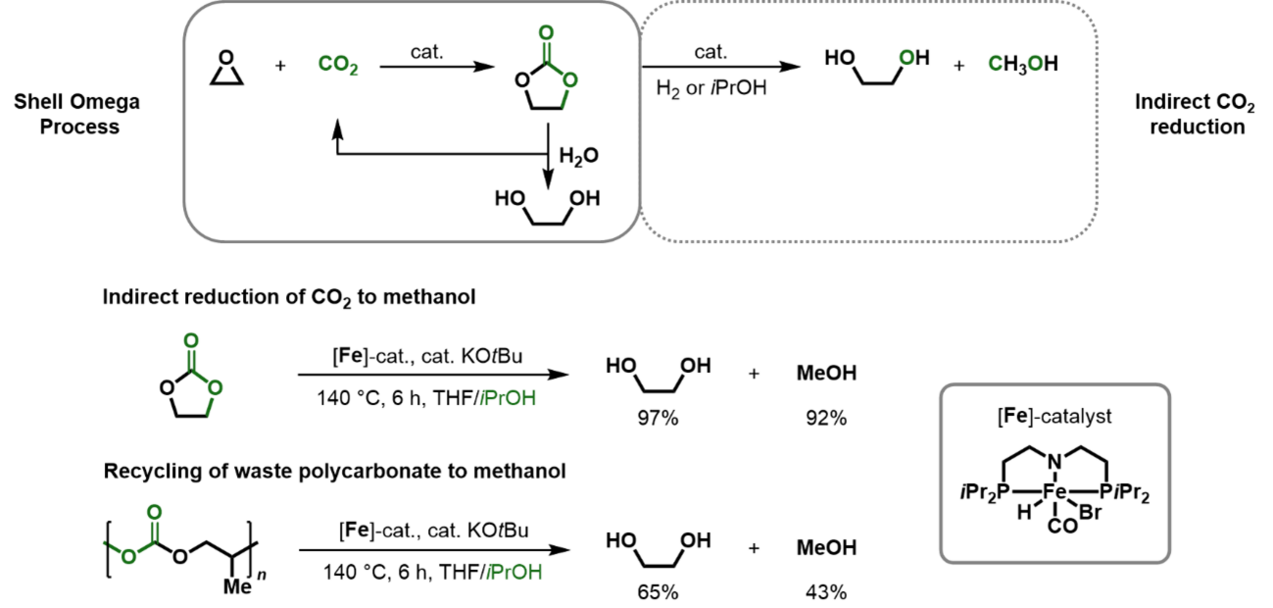
Cyclic carbonates can be used as substrates for the indirect reduction of CO2 to methanol (MeOH). MeOH serves as a solvent, fuel additive, and raw material for other chemicals. We developed an efficient protocol for the transfer hydrogenation of cyclic carbonates utilizing iron pincer complexes as catalyst. Notably, the same catalyst allows also the chemical recycling of polycarbonates leading to diols and MeOH.
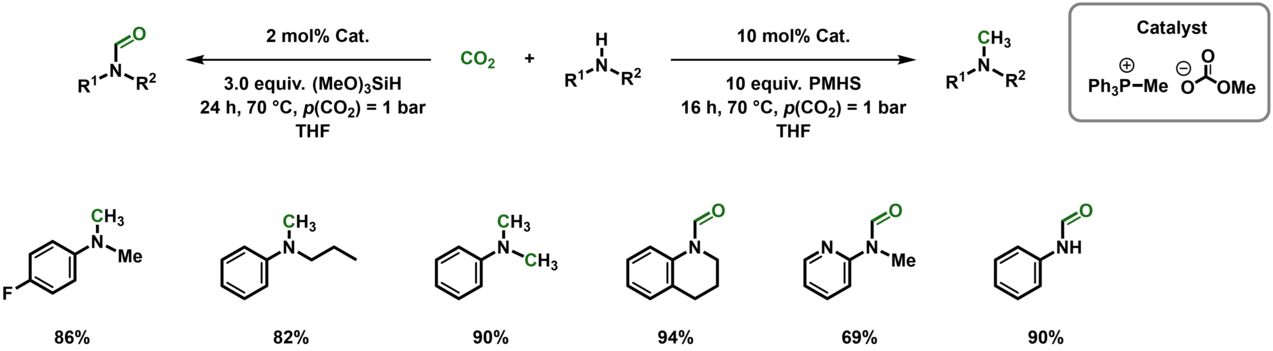
CO2 can also be utilized as a C1 building block in organic synthesis. In this regard we introduced novel catalytic systems for the tunable N-methylation and N-formylation of amines utilizing CO2. Notably, polymethylhydrosiloxane (PMHS) could be utilized as reducing agent for the methylation of amines. PMHS is a byproduct of the silicone industry. It is a cheap, easy to handle, and environmentally friendly reducing agent.
Stoffliche Nutzung von CO2
Das anthropogene Treibhausgas Kohlendioxid (CO₂) entsteht in erster Linie durch die Verbrennung fossiler Ressourcen. Die drei wichtigsten Strategien zur Erreichung einer klimaneutralen Zukunft sind 1) die Substitution fossiler Ressourcen, 2) die Abscheidung und Speicherung von CO₂ (CCS) und 3) die Abscheidung und anschließende Nutzung von CO₂ (CCU) als chemischer Baustein aus der Atmosphäre und aus Industrieabgasen.
Unsere Forschung konzentriert sich auf die Nutzung von CO₂ als C1-Baustein in katalytischen Prozessen zur Synthese wertvoller Folgeprodukte. Dazu gehören die Synthese von cyclischen Carbonaten, die indirekte Reduktion von CO₂ zu Methanol, die Herstellung von Polycarbonaten (PC) und isocyanatfreien Polyurethanen (NIPUs) sowie N-Methylierungs- und N-Formylierungsreaktionen unter Verwendung von CO₂. Derzeit arbeiten wir an CO₂-Abscheidungssystemen, die die Extraktion von CO₂ aus der Atmosphäre ermöglichen.
Bifunktionale Organokatalysatoren
Beispielsweise haben wir homogene bifunktionelle Organokatalysatoren für die Addition von CO2 an Epoxide unter milden Bedingungen entwickelt. Die erhaltenen cyclischen Carbonate finden Anwendung, z. B. als Elektrolyte in Lithium-Ionen-Batterien, Lösungsmittel, Bausteine und Monomere für die Polymersynthese. Die Umwandlung von biobasierten Epoxiden, z. B. epoxidiertem Leinöl und Fettsäurederivaten mit CO2 in katalytischen Prozessen, erfüllt mehrere Kriterien der Grünen Chemie. Die resultierenden Produkte finden Anwendung in der Industrie als Bestandteile von Schmierstoffen, Kosmetika und als Vorläufer für Biokunststoffe.
Recycling von Katalysatoren
Das Recycling von Katalysatoren ist für industrielle Anwendungen von größter Bedeutung. Ein Ansatz ist die Immobilisierung eines Katalysators. Unter Katalysatorimmobilisierung versteht man einen Katalysator, der an einer bestimmten Position fixiert ist und Vorteile wie einfache Trennung, Wiederverwendbarkeit und Vereinfachung der Produktverarbeitung in einem Prozess bietet. Wir arbeiten an der kovalenten Immobilisierung von phosphorbasierten Organokatalysatoren und der nicht-kovalenten Immobilisierung von metallbasierten Katalysatoren für die Synthese von cyclischen Carbonaten aus CO2 und Epoxiden. Beispielsweise haben wir phosphorbasierte Organokatalysatoren auf organischen und anorganischen Trägern immobilisiert. Diese katalytisch aktiven Funktionsmaterialien weisen eine hervorragende Recyclingfähigkeit auf. Die Materialien wurden bis zu 15 Mal ohne Aktivitätsverlust verwendet.
Transferhydrierung von cyclischen Carbonaten
Cyclische Carbonate können als Substrate für die indirekte Reduktion von CO2 zu Methanol (MeOH) verwendet werden. MeOH dient als Lösungsmittel, Kraftstoffzusatz und Rohstoff für andere Chemikalien. Wir haben ein effizientes Protokoll für die Transferhydrierung von cyclischen Carbonaten unter Verwendung von Eisenpinzettenkomplexen als Katalysator entwickelt. Bemerkenswert ist, dass derselbe Katalysator auch das chemische Recycling von Polycarbonaten zu Diolen und MeOH ermöglicht.
CO2 als C1 Baustein
CO2 kann auch als C1-Baustein in der organischen Synthese verwendet werden. In diesem Zusammenhang haben wir neuartige katalytische Systeme für die abstimmbare N-Methylierung und N-Formylierung von Aminen unter Verwendung von CO2 eingeführt. Insbesondere könnte Polymethylhydrosiloxan (PMHS) als Reduktionsmittel für die Methylierung von Aminen verwendet werden. PMHS ist ein Nebenprodukt der Silikonindustrie. Es ist ein kostengünstiges, einfach zu handhabendes und umweltfreundliches Reduktionsmittel.
Publications
Hydroxyl-Functionalized Imidazoles: Highly Active Additives for the Potassium Iodide-Catalyzed Synthesis of 1,3-Dioxolan-2-one Derivatives from Epoxides and Carbon Dioxide
T. Werner, N. Tenhumberg, H. Büttner, ChemCatChem 6 (2014) 3493–3500.
Synthesis of cyclic carbonates from epoxides and CO2 catalyzed by potassium iodide and amino alcohols
T. Werner, N. Tenhumberg, Journal of CO2 Utilization 7 (2014) 39–45.
Phosphorus-based Bifunctional Organocatalysts for the Addition of Carbon Dioxide and Epoxides
T. Werner, H. Büttner, ChemSusChem 7 (2014) 3268–3271.
Recycling of Phosphorus-Based Organocatalysts by Organic Solvent Nanofiltration
J. Großeheilmann, H. Büttner, C. Kohrt, U. Kragl, T. Werner, ACS Sustainable Chemistry and Engineering 3 (2015) 2817–2822.
Synthesis of Cyclic Carbonates from Epoxides and Carbon Dioxide by Using Bifunctional One-Component Phosphorus-Based Organocatalysts
H. Büttner, J. Steinbauer, T. Werner, ChemSusChem 8 (2015) 2655–2669.
Recyclable Bifunctional Polystyrene and Silica Gel-Supported Organocatalyst for the Coupling of CO2with Epoxides
C. Kohrt, T. Werner, ChemSusChem 8 (2015) 2031–2034.
Highly Efficient Polymer-Supported Catalytic System for the Valorization of Carbon Dioxide
W. Desens, C. Kohrt, M. Frank, T. Werner, ChemSusChem 8 (2015) 3815–3822.
Bifunctional One-Component Catalysts for the Addition of Carbon Dioxide to Epoxides
H. Büttner, K. Lau, A. Spannenberg, T. Werner, ChemCatChem 7 (2015) 459–467.
Cooperative catalyst system for the synthesis of oleochemical cyclic carbonates from CO2and renewables
N. Tenhumberg, H. Büttner, B. Schäffner, D. Kruse, M. Blumenstein, T. Werner, Green Chemistry 18 (2016) 3775–3788.
A novel zinc based binary catalytic system for CO2utilization under mild conditions
W. Desens, C. Kohrt, A. Spannenberg, T. Werner, Organic Chemistry Frontiers 3 (2016) 156–164.
Iron-Based Binary Catalytic System for the Valorization of CO2 into Biobased Cyclic Carbonates
H. Büttner, C. Grimmer, J. Steinbauer, T. Werner, ACS Sustainable Chemistry & Engineering 4 (2016) 4805–4814.
Convergent Activation Concept for CO2Fixation in Carbonates
W. Desens, T. Werner, Advanced Synthesis and Catalysis 358 (2016) 622–630.
Calcium-Based Catalytic System for the Synthesis of Bio-Derived Cyclic Carbonates under Mild Conditions
L. Longwitz, J. Steinbauer, A. Spannenberg, T. Werner, ACS Catalysis 8 (2017) 665–672.
Immobilized bifunctional phosphonium salts as recyclable organocatalysts in the cycloaddition of CO2 and epoxides
J. Steinbauer, L. Longwitz, M. Frank, J. Epping, U. Kragl, T. Werner, Green Chemistry 19 (2017) 4435–4445.
An in situ formed Ca2+–crown ether complex and its use in CO2-fixation reactions with terminal and internal epoxides
J. Steinbauer, A. Spannenberg, T. Werner, Green Chemistry 19 (2017) 3769–3779.
Recent Developments in the Synthesis of Cyclic Carbonates from Epoxides and CO2
H. Büttner, L. Longwitz, J. Steinbauer, C. Wulf, T. Werner, Topics in Current Chemistry 375 (2017).
Organocatalyzed Synthesis of Oleochemical Carbonates from CO2and Renewables
H. Büttner, J. Steinbauer, C. Wulf, M. Dindaroglu, H.-G. Schmalz, T. Werner, ChemSusChem 10 (2017) 1076–1079.
Poly(ethylene glycol)s as Ligands in Calcium-Catalyzed Cyclic Carbonate Synthesis
J. Steinbauer, T. Werner, ChemSusChem 10 (2017) 3025–3029.
Mechanistic Study on the Addition of CO2 to Epoxides Catalyzed by Ammonium and Phosphonium Salts: A Combined Spectroscopic and Kinetic Approach
J. Steinbauer, C. Kubis, R. Ludwig, T. Werner, ACS Sustainable Chemistry and Engineering 6 (2018) 10778–10788.
Copolymerization of CO2 and epoxides mediated by zinc organyls
C. Wulf, U. Doering, T. Werner, RSC Advances 8 (2018) 3673–3679.
Calcium-Based Catalytic System for the Synthesis of Bio-Derived Cyclic Carbonates under Mild Conditions
L. Longwitz, J. Steinbauer, A. Spannenberg, T. Werner, ACS Catalysis 8 (2018) 665–672.
Life Cycle Assessment for the Organocatalytic Synthesis of Glycerol Carbonate Methacrylate
H. Büttner, C. Kohrt, C. Wulf, B. Schäffner, K. Groenke, Y. Hu, D. Kruse, T. Werner, ChemSusChem 12 (2019) 2701–2707.
Polyethers as Complexing Agents in Calcium-Catalyzed Cyclic Carbonate Synthesis
Y. Hu, J. Steinbauer, V. Stefanow, A. Spannenberg, T. Werner, ACS Sustainable Chemistry and Engineering 7 (2019) 13257–13269.
Catalytic Systems for the Synthesis of Biscarbonates and Their Impact on the Sequential Preparation of Non-Isocyanate Polyurethanes
C. Wulf, M. Reckers, A. Perechodjuk, T. Werner, ACS Sustainable Chemistry and Engineering 8 (2020) 1651–1658.
Plasma‐Assisted Immobilization of a Phosphonium Salt and Its Use as a Catalyst in the Valorization of CO 2
Y. Hu, S. Peglow, L. Longwitz, M. Frank, J.D. Epping, V. Brüser, T. Werner, ChemSusChem 13 (2020) 1825–1833.
Catalytic, Kinetic, and Mechanistic Insights into the Fixation of CO2 with Epoxides Catalyzed by Phenol‐Functionalized Phosphonium Salts
Y. Hu, Z. Wei, A. Frey, C. Kubis, C. Ren, A. Spannenberg, H. Jiao, T. Werner, ChemSusChem 14 (2021) 363–372.
Indirect reduction of CO2 and recycling of polymers by manganese-catalyzed transfer hydrogenation of amides, carbamates, urea derivatives, and polyurethanes
X. Liu, T. Werner, Chemical Science 12 (2021) 10590–10597.
Selective Construction of C−C and C=C Bonds by Manganese Catalyzed Coupling of Alcohols with Phosphorus Ylides
X. Liu, T. Werner, Advanced Synthesis and Catalysis 363 (2021) 1096–1104.
Synthesis of Cyclic Carbonates Catalyzed by CaI2–Et3N and Studies on Their Biocatalytic Kinetic Resolution
C. Terazzi, K. Laatz, J. von Langermann, T. Werner, ACS Sustainable Chemistry and Engineering 10 (2022) 13335–13342.
Synthesis of Bifunctional Phosphonium Salts Bearing Perfluorinated Side Chains and Their Application in the Synthesis of Cyclic Carbonates from Epoxides and CO 2
C. Ren, A. Spannenberg, T. Werner, Asian Journal of Organic Chemistry 11 (2022).
Chemoenzymatic Synthesis of Chiral Building Blocks Based on the Kinetic Resolution of Glycerol‐Derived Cyclic Carbonates
C. Terazzi, A. Spannenberg, J. von Langermann, T. Werner, ChemCatChem 15 (2023).
Tuneable reduction of CO2 – organocatalyzed selective formylation and methylation of amines
C. Ren, C. Terazzi, T. Werner, Green Chemistry 26 (2024) 439–447.
Phosphonium-Salt-Catalyzed N-Methylation and N-Formylation of Amines with CO2
C. Ren, A. Spannenberg, T. Werner, ACS Sustainable Chemistry & Engineering 12 (2024) 10969–10977.
Show all publications