
Phosphorous-based organocatalysis
Organocatalysis refers to the utilization of small organic molecules to facilitate chemical transformations. Unlike the other two major classes of homogeneous catalysts - organometallic complexes and enzymes - organocatalysts enables catalytic activation without relying on metal centers or structurally complex molecules.
In organic synthesis, many important reactions - such as the Wittig reaction - employ phosphorous-based reagents. A characteristic feature of these transformations is the formation of stoichiometric amounts of phosphine oxides as waste. Our research in organocatalysis primarily focuses on the use of phosphorous-based organocatalysts. In this regard we develop P(III)/P(V) redox-catalyzed transformations. As a key aspect we explore strategies for the in situ reduction of phosphine oxides, enabling their application in P(III)/P(V) redox catalysis.

By implementing these approaches, we aim to replace stoichiometric phosphine reagents in reactions where they are traditionally required, thereby minimizing the formation of phosphine oxide as a waste product.
Reduction of Nitrous Oxide
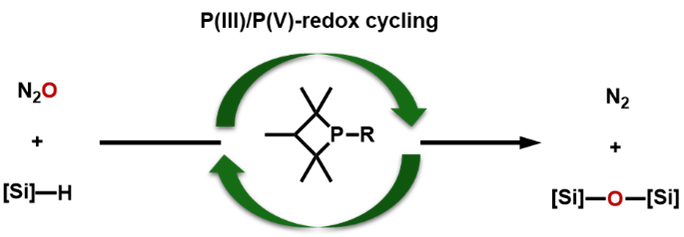
In collaboration with the Paradies working group , for example, we have developed a method for the reduction of nitrous oxide (N2O). N2O is a potent greenhouse gas and dominant ozonedepleting substance. It accounts for 6% of global warming contribution and exhibits a global warming potential over a 100-year timeframe (GWP-100) that is 265 times higher than that of CO2.
Catalytic Hydrogenation with Water
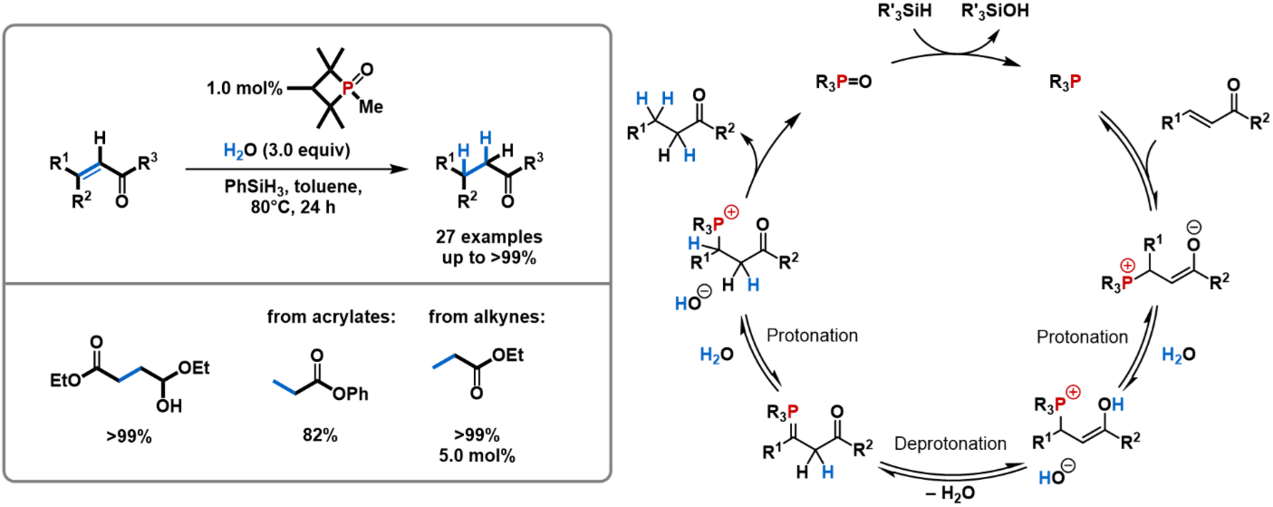
Another example on P(III)/P(V) redox-catalyzed process developed in our group is the formal hydrogenation of a,b-unsaturated carbonyl compounds. Remarkably, in this process hydrogenation was achieved by the transfer of hydrogen from water (H2O).
Catalytic Wittig Reactions
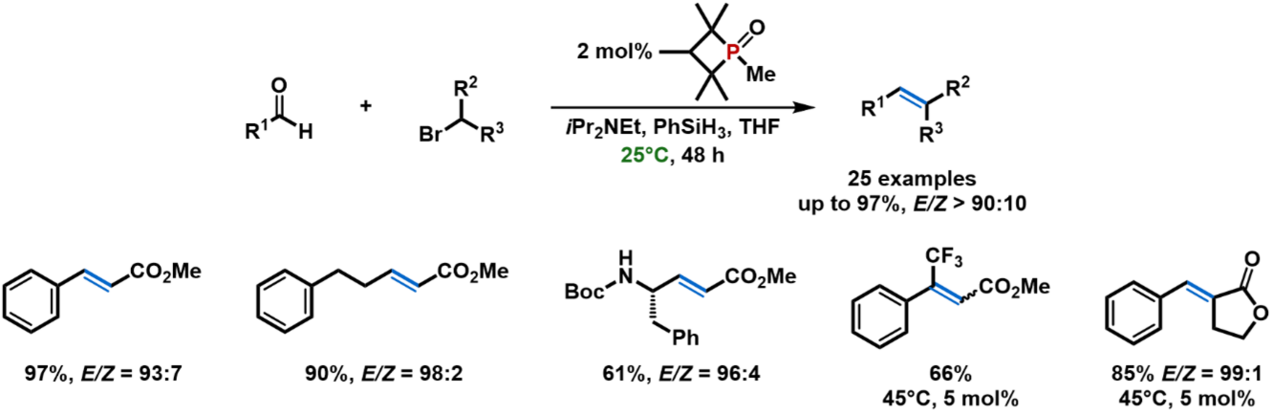
Our group significantly contributed to the advancement of catalytic Wittig reactions. For example, we developed a room-temperature catalytic Wittig reaction based on P(III)/P(V) redox-catalysis.
Catalytic Appel Reactions
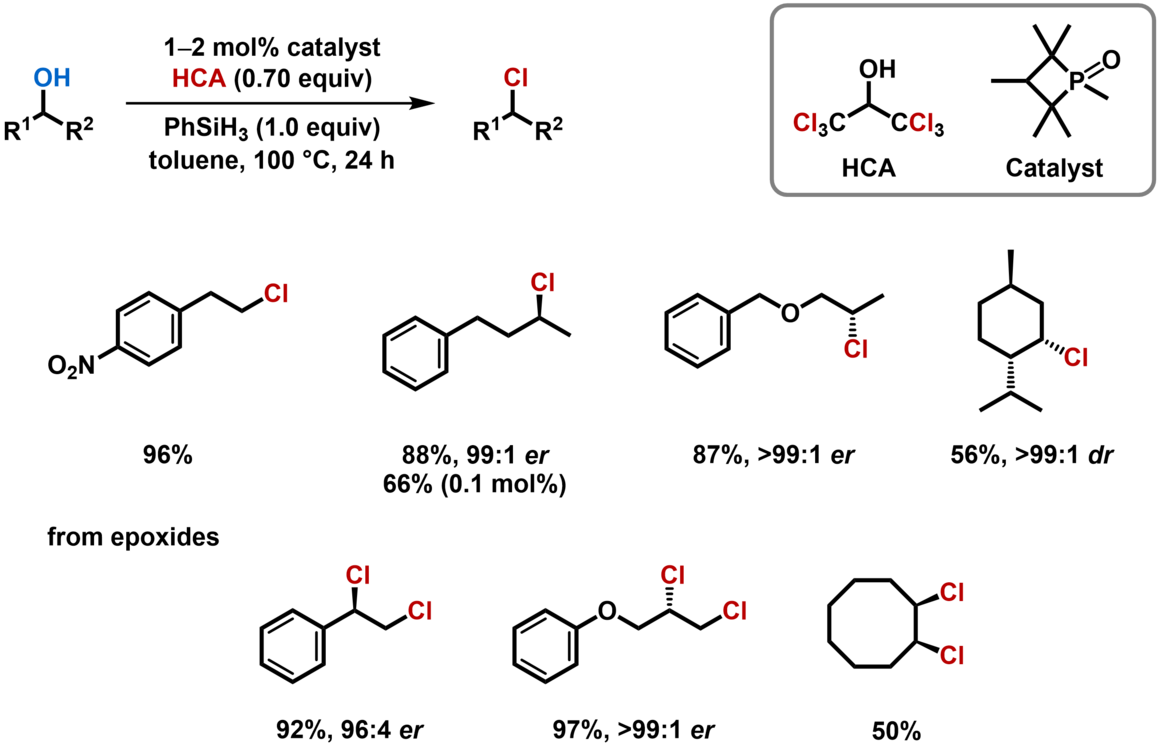
The Appel reaction allows the conversion of alcohols to the corresponding chlorides in the presence of stochiometric amounts of phosphines. We developed catalytic protocols based on P(III)/P(V) redox-catalysis. In the presented example the reaction can even be stereospecific allowing the conversion of chiral alcohols as well as epoxides into the corresponding chlorides.
Another key aspect of our research in phosphorous-based organocatalysis involves transformations that utilize CO₂ as a synthetic building block, e.g. the synthesis of cyclic carbonates as well as selective N-formylation and N-methylation of amines with CO2. More information on this can be found under CO2 utilization.
Publications
Phosphonium Salt Organocatalysis
T. Werner, Advanced Synthesis & Catalysis 351 (2009) 1469–1481.
Phosphonium Salt Catalyzed Addition of Diethylzinc to Aldehydes
T. Werner, A. Riahi, H. Schramm, Synthesis 2011 (2011) 3482–3490.
First Microwave-Assisted Catalytic Wittig Reaction
T. Werner, M. Hoffmann, S. Deshmukh, European Journal of Organic Chemistry 2014 (2014) 6873–6876.
First Enantioselective Catalytic Wittig Reaction
T. Werner, M. Hoffmann, S. Deshmukh, European Journal of Organic Chemistry 2014 (2014) 6630–6633.
Phosphorus-based Bifunctional Organocatalysts for the Addition of Carbon Dioxide and Epoxides
T. Werner, H. Büttner, ChemSusChem 7 (2014) 3268–3271.
Phospholane-Catalyzed Wittig Reaction
T. Werner, M. Hoffmann, S. Deshmukh, European Journal of Organic Chemistry 2015 (2015) 3286–3295.
Crystal structure of diethyl (E)-2-[(benzofuran-2-yl)methylidene]succinate
M.-L. Schirmer, A. Spannenberg, T. Werner, Acta Crystallographica Section E Crystallographic Communications 71 (2015) o872–o872.
Scope and Limitation of the Microwave-Assisted Catalytic Wittig Reaction
M. Hoffmann, S. Deshmukh, T. Werner, European Journal of Organic Chemistry 2015 (2015) 4532–4543.
Recycling of Phosphorus-Based Organocatalysts by Organic Solvent Nanofiltration
J. Großeheilmann, H. Büttner, C. Kohrt, U. Kragl, T. Werner, ACS Sustainable Chemistry and Engineering 3 (2015) 2817–2822.
Synthesis of Cyclic Carbonates from Epoxides and Carbon Dioxide by Using Bifunctional One-Component Phosphorus-Based Organocatalysts
H. Büttner, J. Steinbauer, T. Werner, ChemSusChem 8 (2015) 2655–2669.
Recyclable Bifunctional Polystyrene and Silica Gel-Supported Organocatalyst for the Coupling of CO2with Epoxides
C. Kohrt, T. Werner, ChemSusChem 8 (2015) 2031–2034.
Highly Efficient Polymer-Supported Catalytic System for the Valorization of Carbon Dioxide
W. Desens, C. Kohrt, M. Frank, T. Werner, ChemSusChem 8 (2015) 3815–3822.
First Base-Free Catalytic Wittig Reaction
M.-L. Schirmer, S. Adomeit, T. Werner, Organic Letters 17 (2015) 3078–3081.
Organocatalyzed Reduction of Tertiary Phosphine Oxides
M.-L. Schirmer, S. Jopp, J. Holz, A. Spannenberg, T. Werner, Advanced Synthesis and Catalysis 358 (2016) 26–29.
Highly functionalized alkenes produced from base-free organocatalytic Wittig reactions: (E)-3-benzylidenepyrrolidine-2,5-dione, (E)-3-benzylidene-1-methylpyrrolidine-2,5-dione and (E)-3-benzylidene-1-tert-butylpyrrolidine-2,5-dione
M.-L. Schirmer, A. Spannenberg, T. Werner, Acta Crystallographica Section C Structural Chemistry 72 (2016) 504–508.
Novel Base-Free Catalytic Wittig Reaction for the Synthesis of Highly Functionalized Alkenes
M.-L. Schirmer, S. Adomeit, A. Spannenberg, T. Werner, Chemistry - A European Journal 22 (2016) 2458–2465.
Immobilized bifunctional phosphonium salts as recyclable organocatalysts in the cycloaddition of CO2 and epoxides
J. Steinbauer, L. Longwitz, M. Frank, J. Epping, U. Kragl, T. Werner, Green Chemistry 19 (2017) 4435–4445.
Organocatalyzed Synthesis of Oleochemical Carbonates from CO2and Renewables
H. Büttner, J. Steinbauer, C. Wulf, M. Dindaroglu, H.-G. Schmalz, T. Werner, ChemSusChem 10 (2017) 1076–1079.
Mechanistic Study on the Addition of CO2 to Epoxides Catalyzed by Ammonium and Phosphonium Salts: A Combined Spectroscopic and Kinetic Approach
J. Steinbauer, C. Kubis, R. Ludwig, T. Werner, ACS Sustainable Chemistry and Engineering 6 (2018) 10778–10788.
Phosphetane Oxides as Redox Cycling Catalysts in the Catalytic Wittig Reaction at Room Temperature
L. Longwitz, A. Spannenberg, T. Werner, ACS Catalysis 9 (2019) 9237–9244.
Organocatalytic Chlorination of Alcohols by P(III)/P(V) Redox Cycling
L. Longwitz, S. Jopp, T. Werner, The Journal of Organic Chemistry 84 (2019) 7863–7870.
Recent advances in catalytic Wittig-type reactions based on P(III)/P(V) redox cycling
L. Longwitz, T. Werner, Pure and Applied Chemistry 91 (2019) 95–102.
Intramolecular Base-Free Catalytic Wittig Reaction: Synthesis of Benzoxepinones
A. Grandane, L. Longwitz, C. Roolf, A. Spannenberg, H. Murua Escobar, C. Junghanss, E. Suna, T. Werner, The Journal of Organic Chemistry 84 (2019) 1320–1329.
Reduction of Activated Alkenes by PIII/PV Redox Cycling Catalysis
L. Longwitz, T. Werner, Angewandte Chemie 132 (2020) 2782–2785.
Reduction of Activated Alkenes by PIII/PV Redox Cycling Catalysis
L. Longwitz, T. Werner, Angewandte Chemie International Edition 59 (2020) 2760–2763.
Plasma‐Assisted Immobilization of a Phosphonium Salt and Its Use as a Catalyst in the Valorization of CO 2
Y. Hu, S. Peglow, L. Longwitz, M. Frank, J.D. Epping, V. Brüser, T. Werner, ChemSusChem 13 (2020) 1825–1833.
Benzoxepinones: A new isoform-selective class of tumor associated carbonic anhydrase inhibitors
A. Grandane, A. Nocentini, T. Werner, R. Zalubovskis, C.T. Supuran, Bioorganic and Medicinal Chemistry 28 (2020).
Base-Free Catalytic Wittig-/Cross-Coupling Reaction Sequence as Short Synthetic Strategy for the Preparation of Highly Functionalized Arylbenzoxepinones
T. Werner, A. Grandane, L. Pudnika, I. Domraceva, R. Zalubovskis, Synthesis 53 (2021) 3545–3554.
Poly(methylhydrosiloxane) as a reductant in the catalytic base-free Wittig reaction
J. Tönjes, L. Longwitz, T. Werner, Green Chemistry 23 (2021) 4852–4857.
Synthesis of Bifunctional Phosphonium Salts Bearing Perfluorinated Side Chains and Their Application in the Synthesis of Cyclic Carbonates from Epoxides and CO 2
C. Ren, A. Spannenberg, T. Werner, Asian Journal of Organic Chemistry 11 (2022).
Organocatalytic Stereospecific Appel Reaction
J. Tönjes, L. Kell, T. Werner, Organic Letters 25 (2023) 9114–9118.
Tuneable reduction of CO2 – organocatalyzed selective formylation and methylation of amines
C. Ren, C. Terazzi, T. Werner, Green Chemistry 26 (2024) 439–447.
Phosphonium-Salt-Catalyzed N-Methylation and N-Formylation of Amines with CO2
C. Ren, A. Spannenberg, T. Werner, ACS Sustainable Chemistry & Engineering 12 (2024) 10969–10977.
Synthesis of Amidines Via P(III)/P(V)=O Redox Catalyzed In Situ Formation of Imidoyl Chlorides From Amides
V. Medvaric, J. Paradies, T. Werner, Advanced Synthesis and Catalysis (2025).
Metal-Free Reduction of Nitrous Oxide via PIII/PV═O Cycling: Mechanistic Insights and Catalytic Performance
R. Zhou, V. Medvaric, T. Werner, J. Paradies, Journal of the American Chemical Society (2025).
Show all publications