
Metal oxide/CxNy piezocatalysts for the production of H₂ and H₂O₂ from water (MCN-H2POWER)
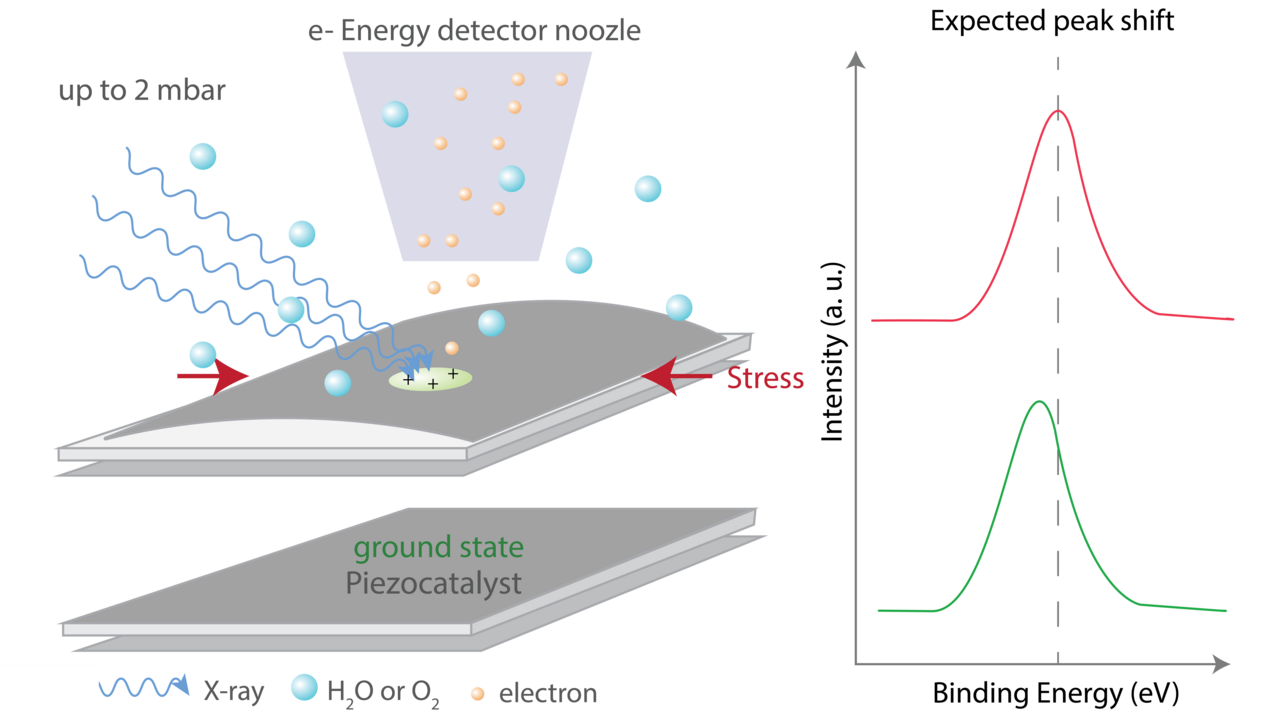
Nations and industries are increasingly investing in novel green energy technologies to achieve their goals of reducing emissions and protecting the environment. However, practical challenges remain in widely used processes such as electrocatalysis and photocatalysis. These include a heavy reliance on precious metal catalysts, high power consumption and low yields of green chemical energy carriers and oxidising agents - particularly hydrogen and hydrogen peroxide.
Therefore, a green and sustainable approach is needed that can produce hydrogen or hydrogen peroxide without the use of precious metals. Currently, piezocatalysis, which converts mechanical energy into sustainable chemical fuels, is emerging as a promising new strategy to tackle the energy crisis and environmental pollution. However, there is still a significant technological and theoretical gap in the development of competitive piezocatalysts.
In response to this challenge, this project aims to develop innovative material solutions and a comprehensive fundamental understanding of a sustainable technique to produce hydrogen or hydrogen peroxide.
- Funding: Postdoctoral fellowship from Paderborn University
- Project management: Dr Ying Pan
Carbon composites as direct Z-scheme photocatalysts for overall water splitting (C2-SPORT)
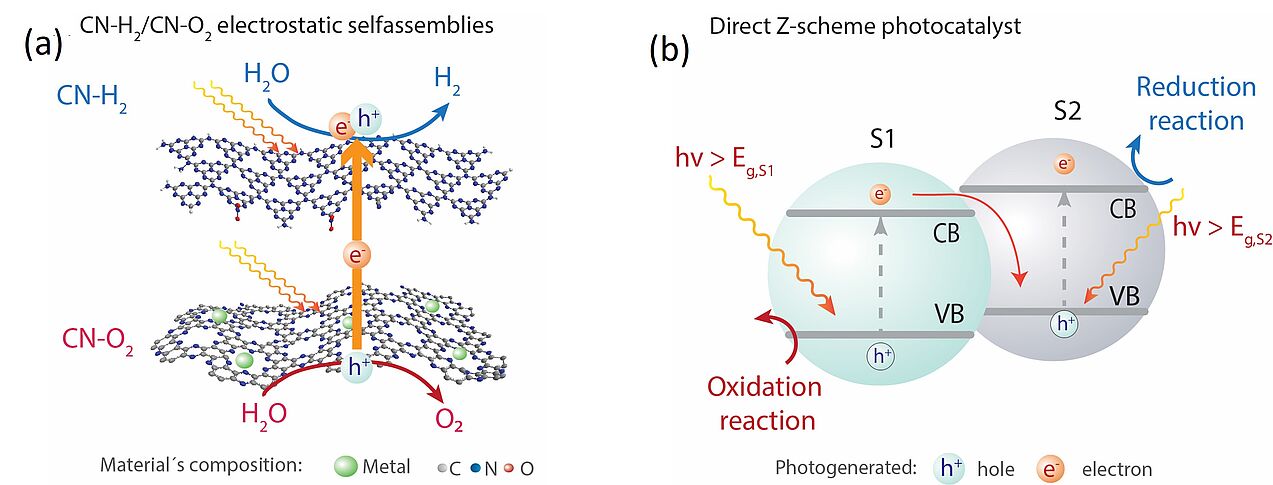
To address the pressing energy and environmental problems, photocatalytic total water splitting has gained considerable attention as a promising method for large-scale production of hydrogen from solar energy and water alone. In the search for low-cost and widely available photocatalysts, carbon nitrides (especially g-C₃N₄), which consist of abundant elements and have suitable band gaps, have emerged as promising alternatives to the commonly used metal-based photocatalysts.
However, despite their potential, carbon nitrides only show activity in hydrogen production when a sacrificial electron donor is introduced into the solution, and their high performance often depends on the use of a noble metal co-catalyst. In addition, the photocatalytic efficiency of carbon nitrides in overall water splitting is limited by ineffective charge separation, which is particularly insufficient to overcome the significant overpotentials of the oxygen evolution reaction.
To overcome these challenges, the C2-SPORT collaborative initiative, involving Paderborn University (Germany), the University of Newcastle (Australia) and Hebei University of Science and Technology (China), aims to develop innovative chemical solutions for sustainable photocatalytic hydrogen production technologies. C2-SPORT will also contribute to trainee four qualified professionals for the clean-tech sector, strengthen international partnerships between Paderborn University and global research institutions and drive joint efforts for a more sustainable and promising future.
- Funding: Wissenschaftskolleg - Paderborn University
- Project management: Dr. Ying Pan, Jun.-Prof. Nieves López Salas, Dr. Sam Chen, A/Prof. Ran Su
Direct synthesis of hydrogen peroxide from water, air and solar energy
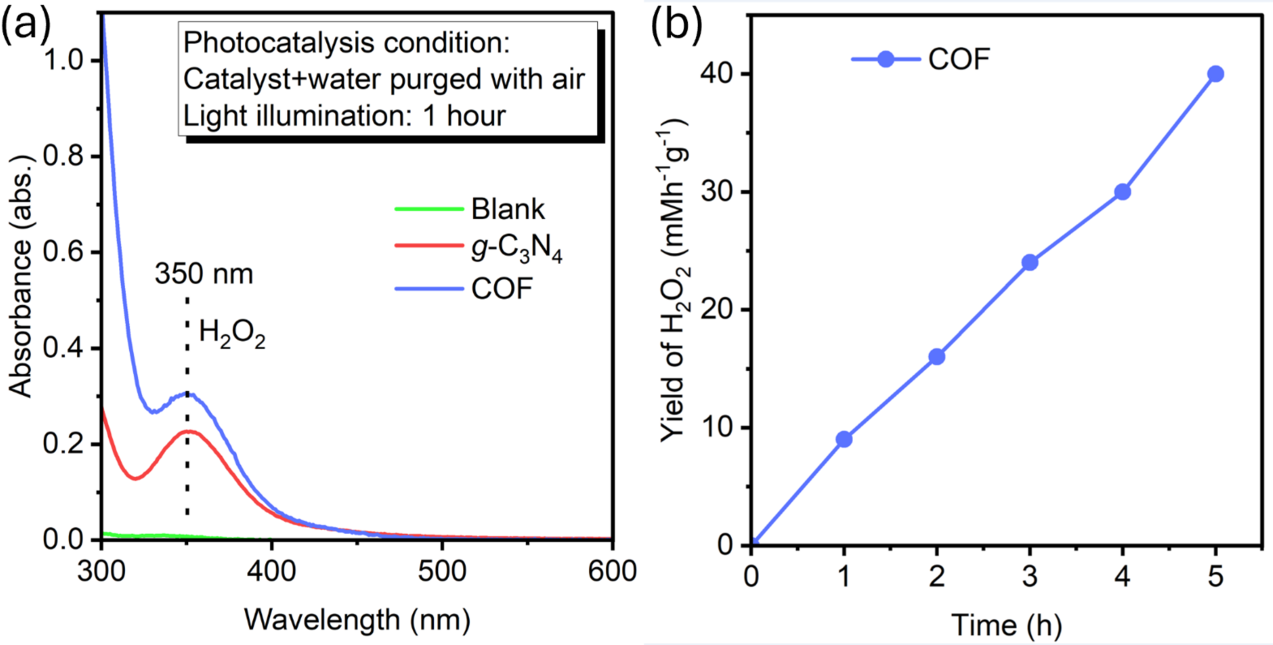
Hydrogen peroxide (H₂O₂) is an extremely versatile reagent that is widely used in the chemical industry, energy storage and water treatment. The photocatalytic production of H₂O₂ from water and air using polymeric semiconductors has recently emerged as a promising and sustainable approach to producing green chemicals and energy carriers. With a focus on efficiency, cost-effectiveness and environmental sustainability, current research aims to identify highly active, cost-effective and environmentally friendly photocatalysts that can maximise H₂O₂ production.
Covalent organic frameworks (COFs) and graphitic carbon nitride (g-C₃N₄) have attracted considerable attention due to their tunable structures, high stability and favourable optical/electronic properties. A particularly effective strategy is to produce COF/g-C₃N₄ composites that synergistically combine the advantages of both components to improve charge separation, enhance surface reaction kinetics and ultimately increase the efficiency of H₂O₂ generation.¹
Project objective:
This project aims to develop and synthesise a g-C₃N₄/COF composite photocatalyst that exploits the complementary properties of both materials. We will systematically investigate the structure-property relationships within the composite and correlate these with the photocatalytic performance in terms of H₂O₂ production. The overall goal is to develop a highly efficient, sustainable and cost-effective photocatalytic system for the green production of H₂O₂.
- Funding: Research Reserve - Paderborn University
- Project management: Shan Wang, Dr. Ying Pan
Carbon precursors with different functional groups for carbonaceous materials with high yields
Carbon materials are widely used in numerous fields such as energy storage, catalysis and electronics. A common synthesis method for carbon materials is carbonisation, in which suitable organic monomers are selected as precursors and then polycondensed into functional carbon materials through heat treatment. The different heteroatoms, structures and properties of the molecular precursors give the end products different properties, which significantly influences their application.
The yield and stability of carbonaceous materials are two crucial properties, especially with regard to their large-scale production and long-term applications. This project aims to systematically investigate how the structure of organic precursors influences carbon yield.
- Project leader: Dr Ying Pan