Transition metal CO₂ batteries as a bridge to a greener future (CO2BATT)
Combating climate change: Recyclable batteries remove CO₂ from the atmosphere
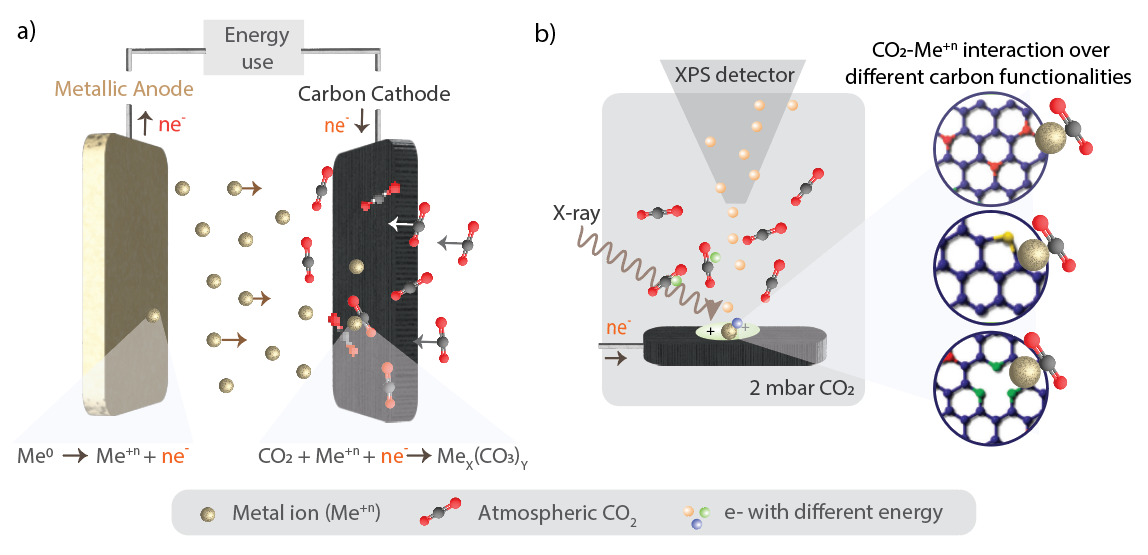
The urgent need to reduce CO₂ emissions to ensure a sustainable future cannot be emphasised enough. By investing in carbon capture, utilisation and storage (CCUS) technologies, renewable energy and energy efficiency measures, we can significantly reduce emissions. Metal CO₂ batteries (MCBs) offer a unique opportunity as they capture CO₂ and convert it into electrical energy - enabling both energy storage and emissions reduction.
However, MCBs are associated with considerable challenges. The specific reaction requirements of CO₂ (low solubility, high overvoltage) and the formation of by-products present major hurdles and make these batteries largely unexplored to date. The anode material (typically Li, Na, K or Mg) is either scarce, safety-critical or both. The cathode, in turn, must be able to efficiently and selectively catalyse CO₂ reduction to the desired product in order to ensure high capacities, good cycle stability and effective charge/discharge processes.
In contrast to today's rechargeable lithium-ion batteries, whose recyclability is largely unexplored despite their long-standing market presence, the chemistry of such a new and promising battery technology should ideally be fully recyclable. This requires (1) aqueous electrolytes, (2) carbon-based materials from renewable sources as cathodes and (3) transition metals as anodes (e.g. Fe, Zn or Al). Such cathode materials are amorphous but require impurities (non-carbon atoms) to achieve high activity and selectivity.
To achieve this, a deep understanding of which carbon centres catalyse the conversion of transition metal ions into carbonates via CO₂ reduction is necessary. This knowledge is particularly lacking in transition metal CO₂ batteries (TMCBs), which are still in their early stages, as most of the research to date has focussed on lithium chemistry.
CO2BATT -Bold Ideas for Science
Media coverage
With the new Climate Protection Act, Germany has committed to becoming greenhouse gas neutral by 2045. In order to achieve this goal, emissions must be avoided, CO₂ removed from the atmosphere and fossil fuels replaced with renewable energy sources. According to experts, however, it will still be necessary after 2045 to capture CO₂ and then use it or store it in deep layers of rock - known by the abbreviations CCS, CCU and CCUS ("Carbon Capture, Utilisation and Storage").
A new research project at Paderborn University is supporting these endeavours and aims to develop so-called "Transition Metal CO₂ Batteries (TMCBs)". These batteries promise not only to store renewable energy, but also to reduce CO₂ emissions.
Junior Professor Dr María Nieves López Salas and PD Dr Teresa de los Arcos de Pedro, both from the Department of Chemistry, have now been awarded the university's research prize.
Partner: Dr Teresa de los Arcos de Pedro
PD Dr Teresa de los Arcos de Pedro's webpage: chemie.uni-paderborn.de/arbeitskreise/technische-chemie/grundmeier/forschung/advanced-surface-and-interface-spectroscopy