Electrochemical Quartz Crystal Microbalance with Dissipation (EC-QCM-D)
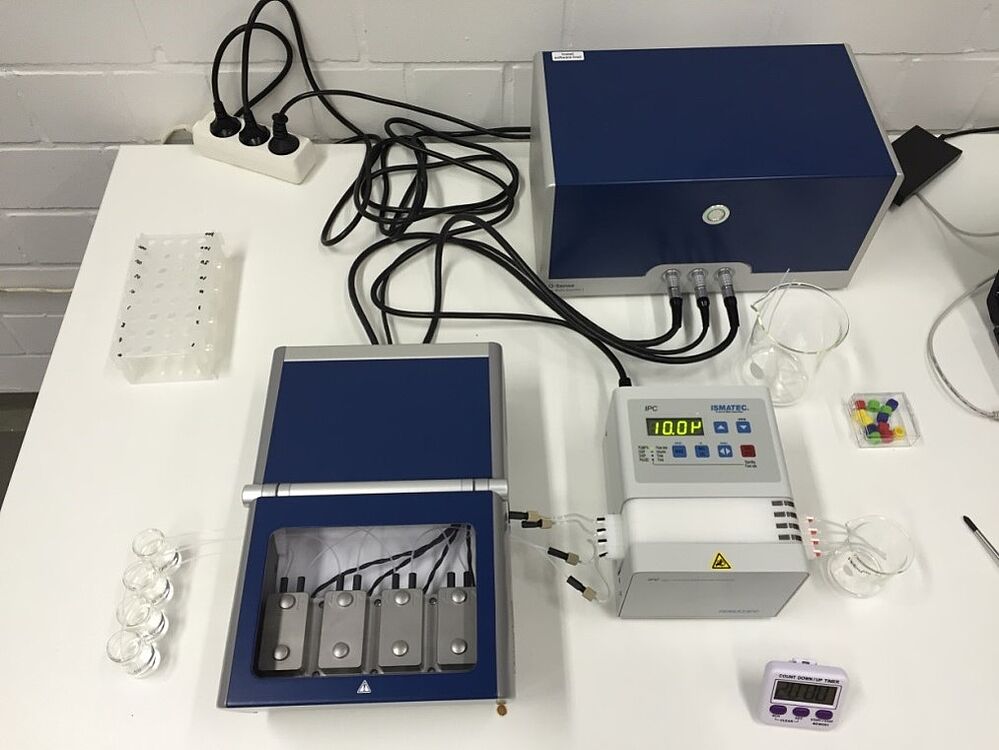
The Quartz Crystal Microbalance (QCM) is based on the piezoelectric properties of quartz. The amount of material adsorbed on the surface is determined on the basis of the change in frequency. Furthermore, by examining the impedance spectrum of the quartz crystal, further properties of the adsorbed film can be inferred. In the electrochemical QCM cell, the quartz crystal is the working electrode. Thus, it is possible to determine the influence of the applied potential on the adsorption or dissolution process.
Measuring the dissipation allows for the analysis of viscosity changes at the interface which is of importance for the analysis of swelling process or the adsorption of soft materials.
Height-Regulated Scanning Kelvin Probe (HR-SKP)
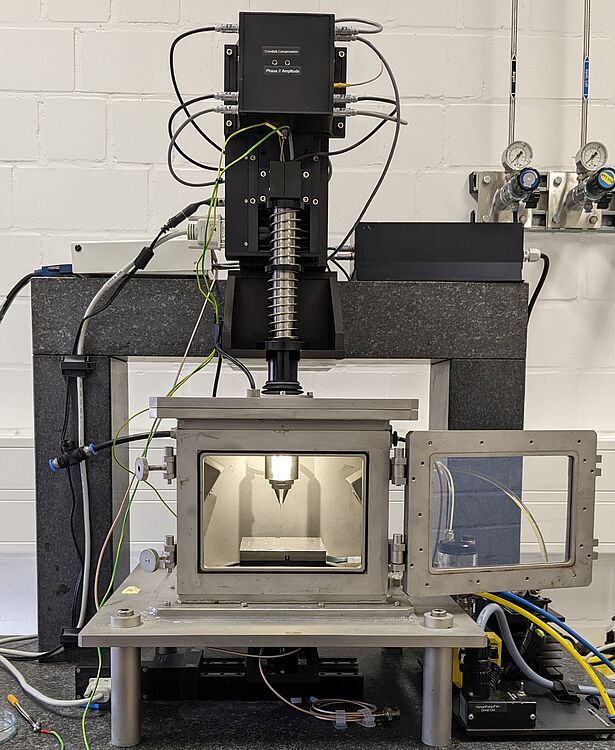
The scanning Kelvin probe (SKP) has established itself in the field of non-destructive measurements of surface and interfacial electrode potentials as well as for the investigation of delamination processes at polymer/oxide/metal interfaces. The height-regulated SKP provides a topographic information in combination with the measured potential distribution.
At the TMC a further advanced approach is the combination of a blister test with the HR-SKP approach which allows for the study of polymer/metal interfaces under combined corrosive and mechanical load.