
Cover Art
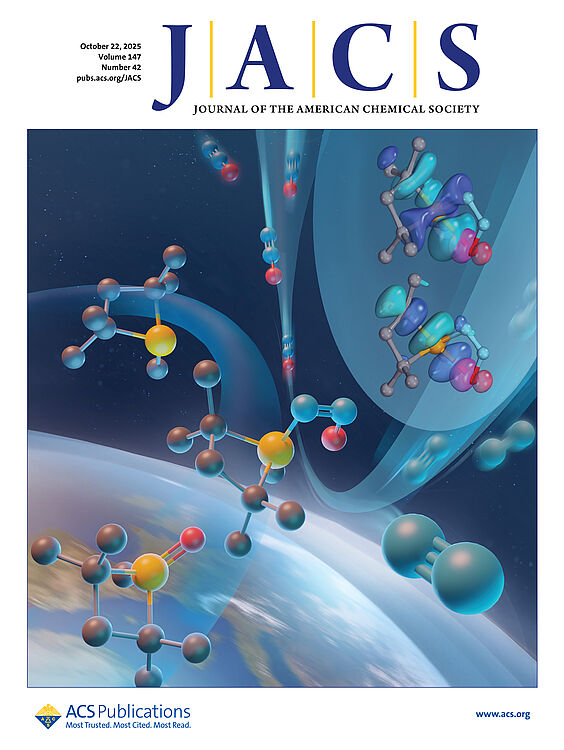
The catalytic reduction of nitrous oxide (N2O) has been achieved through metal-free PIII/PV═O catalysis. Kinetic analysis revealed that the oxygen transfer reaction to the phosphetane is rate determining. Computational investigations support a reaction mechanism in which the phosphetane catalyst preferentially interacts with the nitrogen terminus of N2O, leading to the formation of a P–N═N–O intermediate in the cis configuration. Natural population analysis indicates stabilizing interactions between the occupied nonbonding oxygen orbitals and the antibonding orbitals of the phosphetane backbone, facilitating the oxygen atom transfer. Following nitrogen extrusion, the active phosphetane species is regenerated via silane-mediated reduction. The catalytic activity was quantitatively assessed by monitoring the nitrogen evolution through gas chromatography (GC) analysis.
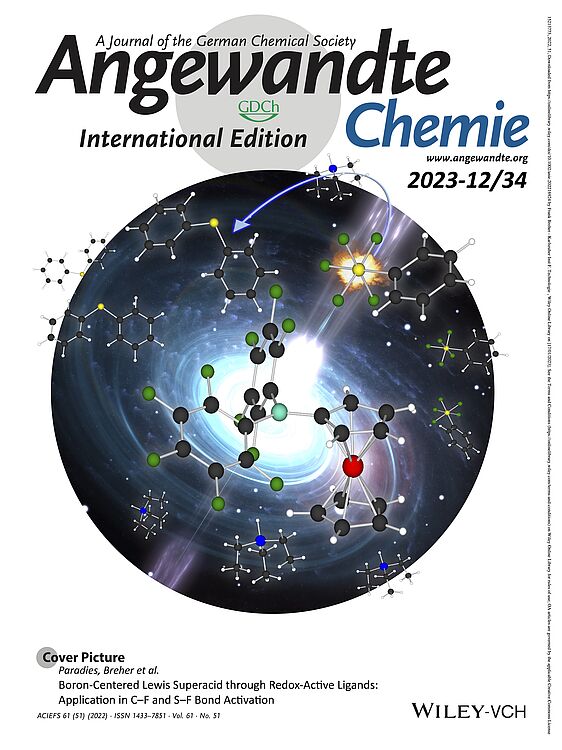
A series of redox-responsive ferrocenyl-substituted boranes and boronic esters were synthesized. Oxidation of the ferrocenyl ligand to the ferrocenium resulted in drastic increase of the Lewis acidity beyond the strength of SbF5, which was investigated experimentally and computationally. The resulting highly Lewis acidic boron compounds were used for catalytic C–F and S–F bond activation.
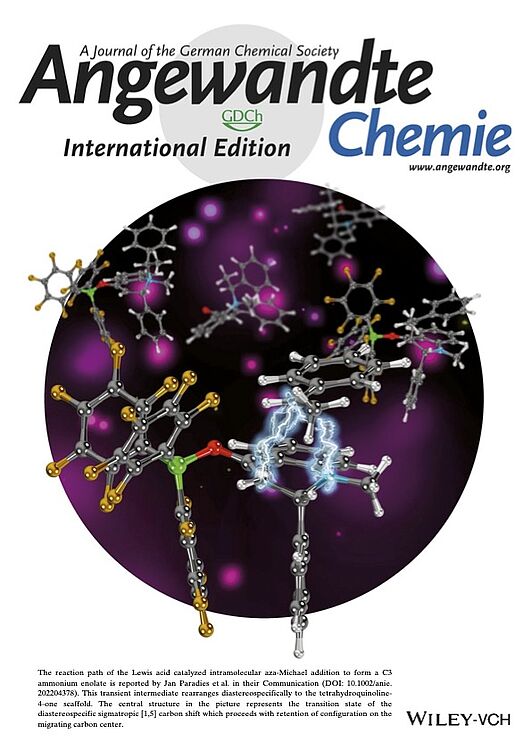
The stereospecific sigmatropic [1,5] carbon shift of C3 ammonium enolates is discovered. According to mechanistic, kinetic and computational experiments, this new rearrangement proceeds via the catalytic generation of a transient C3 ammonium enolate by intramolecular aza-Michael addition. This intermediate rapidly undergoes [1,5] sigmatropic carbon migration to furnish the respective tetrahydroquinoline-4-ones with excellent diastereoselectivities of d.r. > 99:1 and in 61-98% yield.

The synthesis and characterization of a homologous series of quinoid sulfur-containing imidazolyl-substituted heteroacenes is described. The optoelectronic and magnetic properties were investigated by UV/vis, fluorescence and EPR spectroscopy as well as quantum chemical calculations and were compared to the corresponding benzo congener. The room-temperature and atmosphere-stable quinoids display strong absorption in the NIR region between 678–819 nm. The dithieno[3,2- b :2',3'- d ]thiophene derivative and the thieno[2',3':4,5]thieno[3,2- b ]thieno[2,3- d ]thiophene derivative were EPR active at room temperature. For the latter, variable temperature EPR spectroscopy revealed the presence of a thermally accessible triplet state, with a singlettriplet separation of 14.1 kJ/mol.

Gold(I) complexes of ClickPhos [2.2]paracyclophane ligands were synthesized in excellent yields and fully characterized by spectroscopic methods as well as X‐ray crystallography. The complexes exhibit a rigid ligand backbone and a triazolyl moiety and were systematically studied with respect to their cytotoxic properties. In combination with the ionic complex [(GemPhos)Au(tht)][ClO4] (tht=tetrahydrothiophene), in which the gold(I) atom exhibits a distorted trigonal coordination sphere of two phosphines and a labile tht ligand, their efficiency in cytotoxicity was investigated in HeLa, MCF7, and HCT116 cells as well as in a zebrafish model. Their cytotoxicity and their mechanisms of action are different and involve apoptosis, necrosis, and DNA damage. The compounds presented herein are potent metal‐based cytostatics displaying LD50 values from 3.5–38 μm in different tumor cell lines and induce double‐strand DNA breaks (DSB) as shown by H2AX phosphorylation (γH2AX) at foci of DSBs.

“Concise synthesis of dithiophene derivatives by palladium-catalyzed multiple C–S cross coupling/cyclization sequence” Peter Oechsle,a Peng Hou,a Ulrich Flörkeb and Jan Paradiesa*, Adv. Synth Catal. 2016, 7, 3770-3776, DOI:10.1002/adsc.201600802
The facile synthesis of new sulfur-containing fused heterocycles was achieved by a twofold domino reaction consisting of a carbon-sulfur cross coupling, followed by a 5-endo-dig cyclization. Using this strategy a series of benzo, thiopheno, pyridino and pyrazino dithienoacenes with electron-neutral (-C6H4-nHex), electron-rich (-C6H4-NPh2) and electron-deficient (-C4H3N2) substituents were synthesized in high yields. The developed method was applied in the efficient synthesis of a complex donor-acceptor molecule. The photophysical and electrochemical properties of the products were analyzed by UV-VIS/luminescence spectroscopy and cyclic voltammetry.

"Structure-reactivity relationship in the FLP-catalyzed hydrogenation of imines" Sebastian Tussing, Karl Kaupmees and Jan Paradies* Chem. Eur. J. 2016, 22, 7422–7426
The autoinduced, frustrated Lewis pair (FLP)-catalyzed hydrogenation of 16 benzene ring substituted N-benzylidene-tertbutylamines with B(2,6-F2C6H3)3 and molecular hydrogen was investigated by kinetic analysis. The pKa values for imines and for the corresponding amines were determined by quantum-mechanical methods and provided a direct proportional relationship. The correlation of the two rate constants k1 (simple catalytic cycle) and k2 (autoinduced catalytic cycle) with pKa difference between imine and amine pairs (ΔpKa) or Hammett’s σ parameter served as useful parameters to establish a structure-reactivity relationship for the FLP-catalyzed hydrogenation of imines.