
Sputter coater for sample preparation
Scanning electron microscopes use a bundled electron beam to scan the samples. In order for these negative charges to flow off the sample surface, the samples must be suitably conductive. Many materials ( coatings, adhesives, glasses,...) do not fulfill this criteria. On newer scanning electron microscopes, such as the Neon 40 from Zeiss, the scanning parameters can be varied in such cases. Other scanning modes, different aperture sizes and, above all, very low acceleration voltages enable images of poorly conductive to non-conductive samples. However, these settings limit the measurement operation. For example, the possible magnification range with very low acceleration voltage is very limited. In addition, EDX analyses require a minimum acceleration voltage.
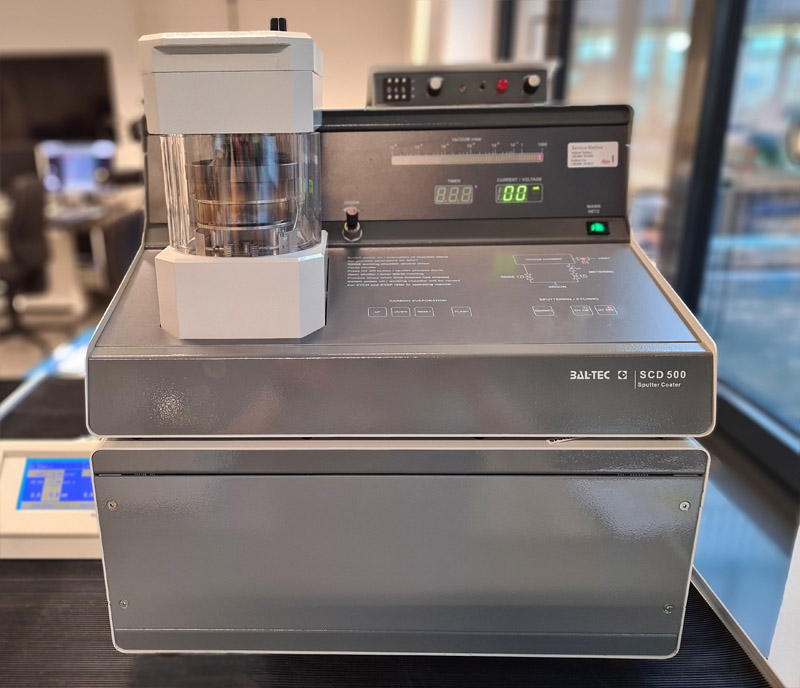
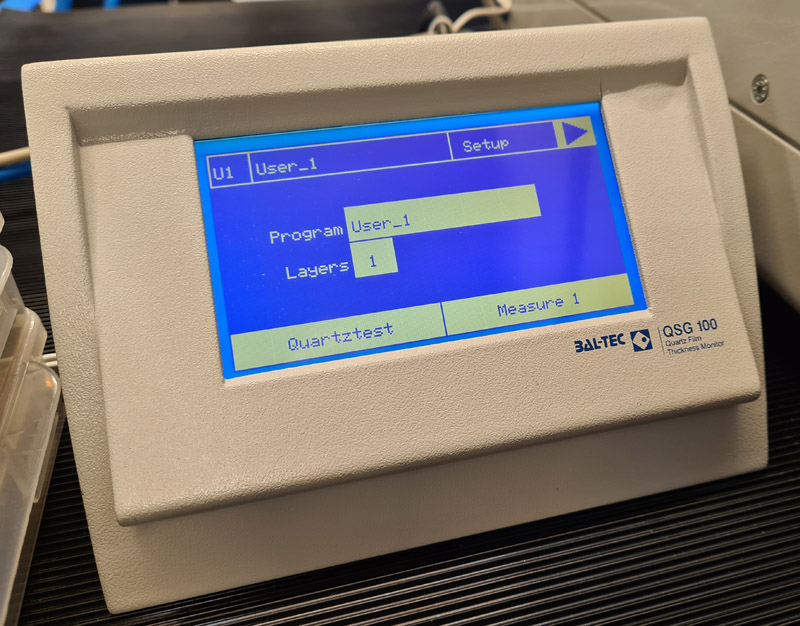
For this reason, non-conductive samples are usually coated with a “super-thin” metal layer using a sputter coater. The CMP working group uses a model SCD 500 sputter coater from BAL-TEC (acquired from Leica). A planetary drive and a microbalance (QSG 100) are installed in the device. The microbalance can be used to set the amount of material to be applied. And thanks to the planetary drive, standard-sized samples are rotated around their own axis during the deposition process, which means they are coated more evenly.